Sales Compensation Software Benchmark | Compare 15+ Platforms (Features, Pricing, User Reviews, etc.)
Download
- Incentive compensation management (ICM) software replaces manual processes with automated, real-time commission tracking.
- The best platforms give sales reps live visibility into their earnings and potential earnings on open deals, which builds trust through the quarter.
- Qobra ranks first in 2026 for transparency and ease of use, with AI assistants for reps, Finance, and RevOps, rated 4.8/5 on G2 and 4.9/5 on Capterra.
- The 2026 ranking compares nine platforms, from enterprise suites like Varicent to fast-deployment tools like Spiff and Everstage.
- According to a Qobra x Modjo study, 61.9% of reps using an ICM tool exceed their sales targets, versus 30.1% without one.
The best incentive compensation management software in 2026 includes Qobra, Compport, Visdum, B EYE (Anaplan-powered), QuotaPath, Compass (formerly Xoxoday Compass), Performio, Spiff by Salesforce, Varicent and Everstage. An incentive compensation management (ICM) platform pulls closed deals and quota data from your CRM, applies plan rules (tiers, accelerators, splits, clawbacks, SPIFFs, MBOs), routes payouts through approvals and sends them to payroll, with an audit trail behind every number. This guide compares the 9 platforms on US payroll and HRIS integrations, pricing in USD, audit trail, rep-facing app and implementation time, then gives a 7-step method to choose the right one for your team.
Key takeaways
- Incentive compensation management software automates the full cycle from CRM deal to payroll file: crediting, calculation, approvals, statements, disputes and audit log. A commission calculator only covers the middle step.
- Two of the 9 platforms publish US prices: QuotaPath (Growth $35 per user per month plus a $525 monthly platform fee) and Compass ($29.99 per user per month for the first 100 users, 50-user minimum). Spiff by Salesforce lists $75 per user per month. The rest are quote-based (vendor websites, Sept 2026).
- US payroll coverage differs widely: Everstage names ADP Workforce, Gusto, Workday, BambooHR, HiBob and Dayforce; Performio names Workday, ADP Workforce Now and BambooHR; Qobra names Workday, BambooHR and HiBob; QuotaPath names Rippling on its Premium plan.
- In a Qobra and Modjo study, 61.9% of reps using an ICM tool exceeded their sales targets, versus 30.1% of reps managed on spreadsheets.
- The fastest way to choose: shortlist three vendors, run one closed quarter of real deals through each in parallel, and compare payouts line by line before comparing prices.
Incentive compensation management software compared (2026)
How we evaluated: vendor pricing and integration pages checked in September 2026; G2 ratings fetched from g2.com in September 2026. "Quote-based" means no public list price. "Not verified" means we could not confirm the item on the vendor site. Commissions are supplemental wages in the US, so every payroll export should carry the federal flat withholding rate of 22% (up to $1M per year) per IRS Publication 15. For the full connector matrix, see Commission Software Integrations Compared.
Sales environments are more competitive than ever. As a result, motivating teams through fair, transparent, and aligned compensation has become a strategic priority for sales leaders. However, many companies still manage bonuses using Excel... or outdated internal tools, leading to errors, disputes, and hours of lost productivity.
This is where the Incentive Compensation Management (ICM) system comes in: a software solution designed to automate and optimize how companies manage incentive compensation plans. In this article, we’ll explore what ICM is, how it differs from traditional compensation methods, and how to choose the right solution for your business.
What is incentive compensation management software for sales?
Let's start with a brief definition of this concept. An Incentive Compensation Management (ICM) system is a digital platform that enables businesses to plan, execute, and monitor sales incentive programs with precision. ICM software automates commission calculations, tracks performance in real-time, and ensures payouts are aligned with actual results and business goals. When designing your incentive compensation plan, consider both automation capabilities and strategic alignment.
An ICM platform differs from a commission calculator and from a full SPM suite in scope. A commission calculator computes payouts from a rate table. An ICM platform adds crediting rules, effective-dated plans, approval workflows, statements, disputes, payroll export and an audit log, which is what US finance teams need for SOX 404 controls and ASC 340-40 commission capitalization. A sales performance management (SPM) suite such as Varicent or Xactly adds territory and quota planning on top. Most mid-market teams need the ICM layer, not the full suite; see Qobra's incentive compensation management solution for what that layer covers.
Why do organizations (should) use ICM systems?
Companies adopt ICM systems to modernize their compensation management processes and:
- Replace manual or error-prone tools like Excel.
- Improve trust and transparency around compensation.
- Reduce administrative workload and manual work for finance and sales ops teams.
- Align sales incentives compensation with corporate strategy and company objectives.with corporate strategy.
- Give sales managers a reliable view of team performance and payouts.
What are the key features of modern ICM software?
Incentive management has moved well beyond commission spreadsheets, and not every incentive software offers the same depth. Here are the capabilities that separate modern platforms from legacy tools:
- Automation at scale: a robust calculation engine runs compensation calculations for thousands of statements in minutes. This processing speed is what removes month-end bottlenecks.
- Accuracy controls: intelligent data checks protect payout accuracy and maintain data consistency across systems.
- Integrations: native data integration with your CRM, ERP, and HRIS keeps the data flow automatic from deal to payment.
- Scenario planning: simulate how new comp plans affect payouts, budget, and team behavior before an official rollout, so you can measure the financial impact of every change.
- Reporting: dashboards give managers real-time insights into plan performance instead of month-end surprises.
- Analytics: strong reporting capabilities let you export incentive data to your business intelligence tools for deeper analysis.
- Governance: approval workflows, audit trails, and hierarchy management keep multi-team organizations compliant.
The common thread: everything runs on a single platform instead of scattered tools.
The best ICM software of 2026
From market leaders to emerging disruptors, here’s a curated selection of the best ICM solutions available this year:
Qobra: Best for Transparency and Ease of Use
G2 Rating: ★★★★★ 4.8 | Capterra Rating: ★★★★★ 4.9
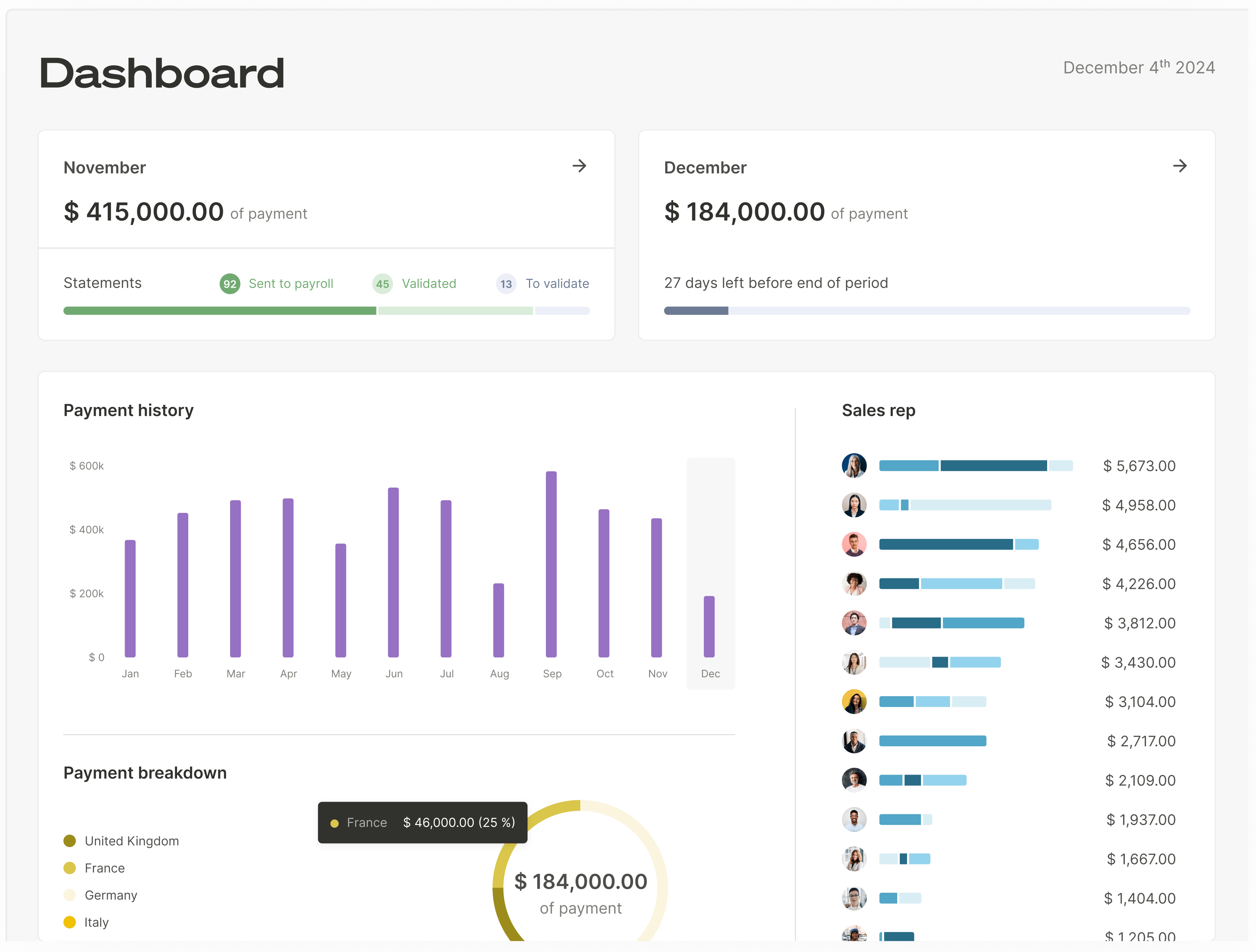
Qobra stands out as the most balanced and modern solution in the market today. Built from the ground up for Sales Ops, Finance, and Sales teams, Qobra brings clarity to complex commission plans through real-time dashboards, automated calculations, and seamless CRM integration (notably with Salesforce and Hubspot).
But beyond automation, what truly sets Qobra apart is its transparency, now amplified by AI. Reps know exactly what they earn, and why, at every stage of the cycle, and can ask the "Explain my comp" assistant in plain language. Finance eliminates back-and-forth and gets reporting insights just by asking a question. And RevOps creates plans and views in natural language, then deploys them with no technical bottlenecks, supported by AI agents that simulate earnings and assist with configuration.
"Since we've had Qobra, we've seen a 15-20% increase in the achievement of objectives."
Tomas Hons, GTM Strategy & Operations Manager at Make
For scaling businesses seeking control and alignment, Qobra delivers a rare mix of power, simplicity, and trust. It’s the benchmark others are measured against.
Qobra, headquartered in New York and Paris, manages $1B+ in commissions across 300+ companies. The platform combines a no-code compensation plan editor, automated calculation with approval workflows, deal-level statements, a dispute workflow, real-time dashboards for reps and managers, and an audit log of every plan and payout change. Native connectors cover Salesforce, HubSpot, Microsoft Dynamics, Zoho, Pipedrive and Odoo for CRM, Snowflake, BigQuery, Redshift, PostgreSQL and Microsoft SQL for data, SFTP and CSV for files, and Workday, BambooHR and HiBob for HRIS (full list on the Qobra integrations page). ADP / Rippling / Gusto / Paylocity payroll: export.
Pricing (USD): quote-based, by number of payees and plan complexity. Get a demo to see your own plans configured and a parallel calculation on one closed quarter.
Compport: Best for Sales Incentives Within a Full Compensation Platform
G2 Rating: ★★★★★ 4.7 | Capterra Rating: ★★★★★ 4.9
Compport is an enterprise compensation platform where sales incentives run alongside merit, bonus, long-term incentives, total rewards, and pay equity, rather than as a standalone commission tool. Reps see real-time performance against every KPI and can simulate potential earnings on the deals in front of them. Sales Ops build plans with a flexible formula builder, set up multiple incentive schemes, map formulas to specific KPIs, and simulate the impact of a new plan instantly before rolling out. Custom approval hierarchies replace the usual chase of emails and reminders when a plan needs sign-off.
What separates Compport in this list is scope. Because incentives sit on the same platform as the rest of the compensation program, Finance and HR see sales pay in the context of total compensation instead of as an isolated feed. It syncs compensation data from your HRIS and reps can track achievement and simulate earnings. Used by large, multi-region organizations across the US, Europe, and ANZ, it pairs that breadth with the governance and audit controls enterprise comp teams need.
Best fit: Enterprises that want sales incentives governed on the same platform as merit, bonus, and total rewards, with approval of workflows and audit trails built for multiple teams and regions.
Watch-out: Compport is a full compensation platform first, so teams shopping for a lightweight, commission-only calculator or heavy RevOps-style gamification may find more depth than they need. It is also a newer name in the standalone ICM category specifically, since its roots are in enterprise compensation management, so confirm the sales incentive depth fits your plan complexity in a live demo.
Visdum: Best for SaaS Finance & RevOps Teams
G2 Rating: ★★★★★ 4.8 | Capterra Rating: ★★★★★ 4.8
Visdum is sales compensation software built for the operational reality of modern SaaS, recurring-revenue, and usage-based businesses. It replaces spreadsheets and legacy ICM tools with one system where Finance owns the numbers, RevOps owns plan design, and Sales owns visibility into payouts.
Where most ICM platforms get thin, Visdum gets specific: ASC 606 commission amortization, multi-currency payouts, audit-ready reporting, clawbacks, overrides, and quota splits across regions. New plans ship without engineering tickets. Month-end close stops waiting on a reconciliation file. Reps see exactly how every commission was calculated, in real time.
Best fit: Mid-market to enterprise SaaS companies with 50+ sellers, multi-region GTM, and Finance teams that need audit-grade compensation infrastructure, not just a calculator.
Watch-out: Built for revenue businesses with real plan complexity. Smaller teams running a single flat-rate plan may not need the full depth.
B EYE (Anaplan-powered): Best for Integrated Planning and Change Control
B EYE offers an Anaplan-powered incentive compensation management solution for companies whose main challenge is not just calculating commissions, but keeping quotas, crediting, calculations, and payout visibility aligned as the business changes. It is especially relevant for organizations dealing with multi-country rules, territory changes, frequent mid-year updates, and exception-heavy plans that create downstream risk.
What makes B EYE different is its planning-grade approach. Rather than treating commissions as a standalone workflow, it connects quota allocation, crediting logic, scenario modeling, governance, and payout calculations in one governed model. That makes it a strong fit for organizations that need explainability, controlled change, and stronger operational consistency across Sales, Finance, and leadership.
Best fit: Companies with complex plans, multi-country operations, or frequent plan changes that make disconnected tools hard to govern.
Watch-out: This is a more implementation-led, Anaplan-based approach than a plug-and-play commission SaaS, so buyers should confirm internal ownership readiness, integration scope, and whether they actually need integrated planning depth.
QuotaPath: Best for Growing Sales Teams
G2 Rating: ★★★★★ 4.7 | Capterra Rating: ★★★★☆ 3.8
QuotaPath has gained strong adoption among startups and mid-market companies thanks to its ease of setup and user-friendly interface. It simplifies compensation planning and provides reps with quick visibility into their earnings, ideal for fast-paced sales environments.
The tiered pricing model supports scalability, but its analytics and customization remain limited for companies with intricate plan logic or large global teams.
Best fit: Growth-stage companies prioritizing speed over complexity.
Watch-out: May fall short for enterprise-grade reporting and governance.
US integrations and pricing (verified): QuotaPath publishes its prices: Growth at $35 per user per month plus a $525 monthly platform fee, Premium at $50 per user per month plus an $800 monthly platform fee, both billed annually with the first 5 users included in the platform fee, plus a 14-day free trial. Rippling payroll sync, QuickBooks, NetSuite and Sage Intacct are Premium-only (quotapath.com/pricing, Sept 2026).
👉 Discover QuotaPath’s Alternatives
Xoxoday Compass: Best for Multi-Geo & Complex Incentive Structures
G2 Rating: ★★★★★ 4.6 | Capterra Rating: ★★★★☆ 4.3
Xoxoday Compass is a comprehensive Incentive Compensation Management platform built for organizations operating with multi-layered, multi-geo incentive structures. It centralizes modeling, administration, and payout execution while giving sales teams real-time visibility into goals, earnings, and performance progress.
Where Compass stands out is in its advanced rule engine, designed to support quotas, tiers, accelerators, clawbacks, SPIFFs, and complex cross-team logic. Combined with automated workflows and robust governance, it’s a strong option for enterprises needing both flexibility and compliance.
Best fit: Organizations with multi-region, multi-role, or highly customized incentive structures needing strong governance and scalability.
Watch-out: Advanced configuration may require more onboarding support for first-time ICM users, and the platform is best suited for mid-market to enterprise teams with established sales operations.
US integrations and pricing (verified): Compass is one of the few ICM tools with public pricing: $29.99 per user per month for the first 100 users, $19.99 for users 101 to 500 and $9.99 above 500, with a 50-user minimum and CRM integrations billed separately. Named connectors are Salesforce, HubSpot, Zoho CRM and Close CRM plus SFTP and SQL; no US payroll or HRIS system is named. Reps use a native iOS and Android app (getcompass.ai, Sept 2026).
Performio: Best for Regulated Industries
G2 Rating: ★★★★☆ 4.4 | Capterra Rating: ★★★★☆ 4.3
Performio is a robust tool tailored for enterprises with compliance-heavy requirements. Its strength lies in handling complex incentive structures and delivering detailed audit trails, features that are critical in finance, insurance, and pharmaceuticals. This industry focus makes it a natural shortlist candidate in regulated sectors.
However, the learning curve can be steep. Its interface is more functional than intuitive, and technical support is often needed for implementation and plan changes.
Best fit: Large enterprises with compliance obligations and complex plans.
Watch-out: Less agile for small teams or non-technical users.
US integrations and pricing (verified): Performio lists Salesforce, HubSpot and Microsoft Dynamics for CRM, NetSuite and SAP for ERP, and Workday, ADP Workforce Now and BambooHR for HRIS and payroll. Pricing is quote-based, built from a subscription by payees and admin seats plus a one-time implementation fee. Reps get the Performio SPM app on iOS and Android (performio.co, Sept 2026).
Spiff by Salesforce: Best for High-Growth Startups
G2 Rating: ★★★★★ 4.6 | Capterra Rating: ★★★★★ 4.7
Spiff shines with its sleek interface and rapid onboarding. It’s a favorite among startups seeking to move fast and offer reps real-time incentive visibility. Forecasting tools and clean UI make it easy to adopt across fast-moving sales teams.
Yet, Spiff’s configurability can be limiting for companies with complex compensation logic or large international structures. Agile, yes, but not deeply customizable.
Best fit: Tech-forward startups wanting quick wins.
Watch-out: Scalability may be constrained as teams and territories grow.
US pricing (verified): Salesforce closed its acquisition of Spiff on February 1, 2024 and now sells it as Salesforce Spiff, a Sales Cloud add-on at $75 per user per month billed annually, with additional external connectors at $250 per connector per month and Premium Support at 30% of net price (salesforce.com pricing page, Sept 2026). Teams on HubSpot or Microsoft Dynamics should confirm connector coverage before shortlisting.
👉 Discover SPIFF’s Alternatives
Varicent: Best for Enterprise Complexity
G2 Rating: ★★★★★ 4.5 | Capterra Rating: ★★★★★ 5
Varicent is the heavyweight in this space. Designed for Fortune 500-scale organizations, best ICM software. It’s a full Sales Performance Management (SPM) suite rather than a standalone ICM tool.
That power comes at a cost: implementation is long, total cost of ownership is high, and compensation administrators are often required.
Best fit: Mature enterprises with complex sales ecosystems.
Watch-out: Overkill for smaller businesses or companies seeking fast deployment.
Pricing (verified): quote-based; Varicent does not publish prices or named US payroll connectors on its product pages (varicent.com, Sept 2026). Enterprise teams comparing SPM suites can also read Qobra vs Xactly.
Everstage: Best for Sales Motivation and Engagement
G2 Rating: ★★★★★ 4.8 | Capterra Rating: ★★★★★ 4.8
Everstage brings a refreshingly dynamic and gamified approach to incentive compensation. Leaderboards, real-time dashboards, and clear visualizations help reps stay focused and competitive. It’s particularly well-suited for motivating younger or remote sales teams.
While still maturing in terms of depth and integrations, Everstage is building credibility quickly among fast-scaling teams.
Best fit: Teams prioritizing culture, visibility, and engagement.
Watch-out: Still evolving in terms of enterprise-grade depth and custom logic.
US integrations and pricing (verified): Everstage names ADP Workforce, Gusto, Workday, BambooHR, HiBob and Ceridian Dayforce for HR and payroll, plus NetSuite, QuickBooks and Sage Intacct for accounting. Pricing is quote-based per payee with an onboarding fee, and the ASC 606 module is sold as an add-on; the vendor states go-live typically takes 4 to 6 weeks (everstage.com, Sept 2026).
👉 Discover Everstage’s Alternatives
ICM Software Comparison: A Quick Recap
For US payroll integrations, pricing in USD, audit trail, rep-facing app and implementation time, see the "Incentive compensation management software compared (2026)" table at the top of this article. The recap below covers positioning by growth stage.
If you are short on time or just want a quick recap of the tools we have covered, here is a summary table comparing the strengths and watch-outs of the best ICM software based on your growth stage.
How do I choose the right incentive compensation management software? A 7-step method
To choose the right incentive compensation management software, list your plan mechanics, map your data sources, check US payroll and compliance requirements, shortlist three vendors, run a parallel calculation on one closed quarter, price the total cost of ownership over three years, and test the rep experience. The seven steps below take two to four weeks for most mid-market teams.
- List every plan mechanic you actually use. Tiers (retroactive or marginal), accelerators, splits, clawbacks, draws, SPIFFs, MBOs, multi-currency, mid-period plan changes. A vendor that handles all but one natively leaves you with a spreadsheet for that one.
- Map data sources and sync frequency. CRM (Salesforce, HubSpot, Dynamics), billing or ERP (NetSuite, Sage Intacct), data warehouse (Snowflake, BigQuery), HRIS (Workday, BambooHR, HiBob, Rippling). Real-time sync matters for rep dashboards; batch is acceptable for payroll.
- Check US payroll and compliance needs. Payroll export format for ADP, Paylocity, Gusto or Rippling; supplemental wage withholding at the 22% federal flat rate; an audit log for SOX 404 controls; capitalization schedules for ASC 340-40 commission accounting; written commission agreements where state law requires them (for example California Labor Code 2751).
- Shortlist three vendors from the table above by company size and stack. Enterprise SPM needs point to Varicent, Xactly or Performio; SaaS metrics point to Visdum; total compensation governance points to Compport; mid-market teams that want Ops, Finance and Sales on one tool point to Qobra or Everstage; small teams with public pricing point to QuotaPath or Compass.
- Run a parallel calculation. Give each finalist one closed quarter of real deals and your current plan documents. Compare payouts line by line against what you actually paid. Every gap should be explained by a documented rule, not by a calculation difference.
- Price the three-year total cost of ownership. License plus setup fee, per-connector fees, ASC 606 or reporting add-ons, professional services for plan changes, and internal admin time. Our sales commission software pricing guide lists the fee types by vendor.
- Test the rep experience. Have two reps and one manager use the dashboard and dispute workflow during the trial. Adoption, not features, decides whether shadow accounting disappears.
If you already run an ICM tool and want to benchmark it, use the free incentive compensation system evaluation tool. To model the budget impact of a new plan before you buy, see sales compensation modeling software.
Which criteria should be considered when selecting incentive compensation software?
Choosing the right ICM solution depends on the specific needs and maturity of your sales organization. Here are the most critical selection criteria:
1. Plan Complexity & Team Size
- Small teams with simple sales commission plans may manage with basic tools.
- Larger teams or multi-layered compensation structures require advanced automation and scalability.
2. Integration with Your Tech Stack
- Ensure compatibility with your CRM (e.g. Salesforce), ERP, and payroll systems.
- Real-time sync of compensation data is key to transparency and efficiency.
3. Ease of Use
- Look for platforms that are easy to configure and intuitive for all users, not just Ops or IT.
4. Visibility & Transparency
- Choose software that offers real-time dashboards and clear payout explanations that build trust and employee engagement.
5. Support & Implementation
- A dedicated customer success team and solid onboarding process can make or break adoption for your compensation team.
6. Regulatory Compliance & Auditability
- Your compensation system should support compliance with local labor and financial regulations, and make audits straightforward.
- For US teams this means an audit log of plan and payout changes for SOX 404, commission capitalization data for ASC 340-40, payroll files that apply supplemental wage withholding, and support for state written-agreement rules such as California Labor Code 2751. See commission software audit trails for SOX and ASC 606.
How much does incentive compensation management software cost in the US?
Most incentive compensation management software is quote-based, priced per payee per month plus a one-time setup fee; the public list prices range from $29.99 per user per month (Compass, first 100 users) to $75 per user per month (Spiff by Salesforce). QuotaPath publishes $35 to $50 per user per month plus a $525 to $800 monthly platform fee (vendor websites, Sept 2026).
- Quote-based, per payee plus setup fee: Qobra, Visdum, Performio, Everstage, CaptivateIQ, Compport, Varicent, B EYE.
- Watch for add-ons: ASC 606 reporting (CaptivateIQ, Everstage), extra connectors ($250 per connector per month at Spiff by Salesforce), premium support tiers, and professional services for plan changes.
- Budget the internal side too: admin time per cycle, the parallel-run period, and rep training. Use the ROI calculator and sales compensation ROI analytics to build the business case.
Final Thoughts
An Incentive Compensation Management system is much more than a commission calculator. It is a strategic asset that connects your sales strategy to day-to-day execution, drives performance, and frees up time for what really matters: selling. It is also how teams build effective compensation plans over time: test, measure, adjust.
For businesses ready to move beyond Excel and regain control of their compensation strategies, modern ICM software like Qobra offers transparency, speed, and confidence in every payout.
Ready to see how our software can help you boost performance and reduce complexity?
Qobra appears in this comparison as a vendor; the detail of what it covers — no-code plan design, real-time CRM sync, individual statements, approval workflows — is on the page dedicated to Qobra's incentive compensation management solution.
FAQ - ICM Software
What is the best incentive compensation management software?
The best incentive compensation management software depends on company size and stack. For mid-market and enterprise teams that want Ops, Finance and Sales on one platform, Qobra, Everstage and Performio are the strongest fits in this comparison; Varicent and Xactly suit Fortune 500-scale SPM programs; Visdum suits SaaS metrics; Compport suits total compensation governance; QuotaPath and Compass suit smaller teams that want public pricing. Validate any choice with a parallel run on one closed quarter.
How do I choose the right incentive compensation management software?
List the plan mechanics you use, map your CRM, ERP and HRIS data sources, check US payroll export and compliance needs (SOX 404 audit log, ASC 340-40 data, 22% supplemental withholding), shortlist three vendors, run a parallel calculation on real deals, price the three-year total cost of ownership including setup fees and add-ons, and test the rep dashboard with two reps. The 7-step method above details each step.
What is an ICM platform?
An ICM (incentive compensation management) platform is software that automates the full incentive cycle: it credits deals from the CRM, applies plan rules such as tiers, accelerators, splits and clawbacks, routes payouts through approvals, publishes statements to reps, handles disputes, exports to payroll and keeps an audit log of every change. It sits between a commission calculator and a full sales performance management (SPM) suite that adds territory and quota planning.
Does incentive compensation software integrate with US payroll systems?
Yes, but coverage varies. Everstage names ADP Workforce, Gusto, Workday, BambooHR, HiBob and Dayforce; Performio and CaptivateIQ name Workday, ADP Workforce Now and BambooHR; Visdum names Workday, ADP, Paychex, HiBob and Deel; QuotaPath names Rippling on its Premium plan; Qobra names Workday, BambooHR and HiBob and exports to any payroll by CSV or SFTP (vendor websites, Sept 2026). Confirm the format your payroll provider accepts and whether the connector is native or file-based.
How long does it take to implement incentive compensation management software?
Self-serve tools such as QuotaPath and Compass go live in days to weeks. Mid-market platforms typically take 4 to 8 weeks: Everstage states 4 to 6 weeks and Visdum cites an average of about 0.65 months (vendor websites, Sept 2026). Enterprise SPM suites such as Varicent, Xactly and Anaplan-based deployments run three to six months or more. Plan for one parallel commission cycle before cutover regardless of vendor.
What is the impact of effective ICM on employee performance?
Accurate, transparent, and timely commissions lead to better sales focus, stronger motivation, and higher retention rates. According to a study by Qobra and Modjo, 61.9% of reps using an ICM tool exceeded their sales targets, compared to just 30.1% using spreadsheets.
How to choose the right ICM software for my organization?
Start from your maturity: the six criteria above (plan complexity, integrations, ease of use, visibility, support, compliance) form a practical checklist. Weigh them against your internal bandwidth, shortlist two or three vendors, and test the rep-facing experience in a live demo before comparing prices.
What are common challenges in managing incentive compensation?
- Manual errors and disputes due to spreadsheets
- Lack of real-time visibility for reps
- High admin burden for Ops and Finance
- Misalignment between incentives and the broader sales and marketing strategy
To address these challenges effectively, it's essential to track the right metrics in your incentive compensation programs.
How can ICM be integrated with existing sales processes?
A good ICM system should sync directly with your CRM, ingest deal data and sales performance data automatically, and reflect real-time quota attainment. This integration allows for incentive payouts without lag or manual intervention.
Can ICM software manage more than sales commissions?
Yes. Most platforms handle bonuses, SPIFFs, and MBOs alongside commissions, and some connect to broader total compensation tools so HR and Finance see the full picture of pay.
Related guides
- Best sales commission software for enterprise teams and for mid-market companies: shortlists by company size.
- Commission software integrations compared: CRM, HRIS, payroll and data warehouse matrix.
- Best commission reporting and analytics software: dashboards, statements and finance reporting compared.
- Commission software audit trails for SOX and ASC 606: what US finance teams need from the audit log.
Next step: bring one closed quarter of deals and your plan documents to a Qobra demo. We configure your plans in the no-code editor and run the calculation next to your current numbers so you can compare every payout before you decide.